GameStop’s Bold eBay Bid: From Awkward Interviews to Selling Cards on the Platform
In a move that has stunned the business world, GameStop announced an unsolicited offer to acquire eBay for nearly $56 billion. The proposal, revealed on a Sunday, quickly became the talk of Wall Street—not just for its audacity, but for the peculiar events that followed. From a tense CNBC interview to a cheeky social media post about selling collectibles, GameStop CEO Ryan Cohen has kept the spotlight firmly on the potential merger.
The Surprise Bid: A David vs. Goliath Attempt
GameStop, a company known primarily for video game retail, has set its sights on the e-commerce giant eBay. eBay currently boasts a market capitalization of about $46 billion, while GameStop’s own value stands at roughly $11 billion. The proposed $56 billion acquisition would be financed through a combination of half cash and half stock, according to details published on GameStop’s website. The company has $9 billion in cash reserves and secured a $20 billion financing confidence letter from TD Securities, but that still leaves a significant gap of approximately $16 billion.
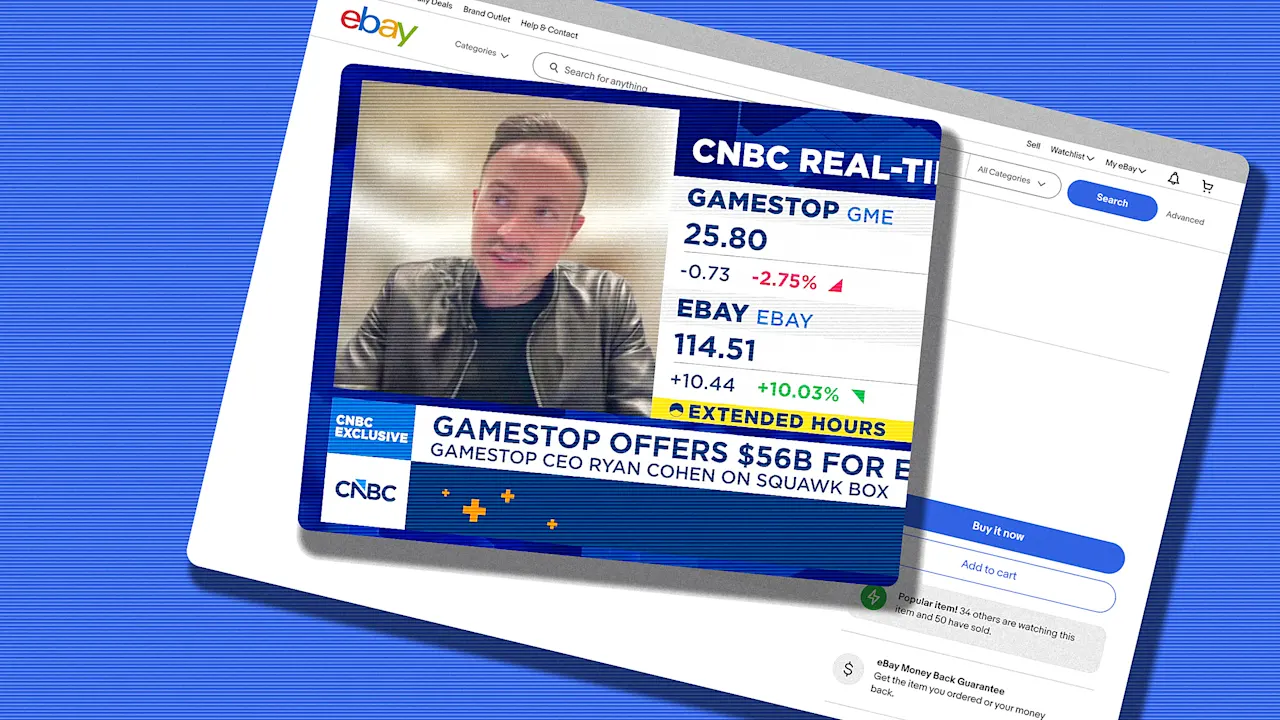
The Contentious Interview: Evasion Meets Frustration
The day after the announcement, Cohen sat down with CNBC co‑anchor Becky Quick for an interview that media outlets quickly described as “bizarre,” “awkward,” “evasive,” and “dizzying.” Rather than offering clear explanations, Cohen repeatedly deflected questions about the financial mechanics of the deal. When asked how GameStop would cover the funding shortfall, his response was terse: “It’s on our website. Half cash, half stock, but the details are on our website.”
Quick pressed further: “That’s a pretty straightforward question. I don’t get it. Where’s the rest of the money coming from?” Cohen’s reply did little to clarify: “I don’t understand your question. We’re offering half cash, half stock. We have the ability to issue stock in order to get the deal done, but the full details of the offer are on our website.” The exchange left many viewers frustrated, with Quick openly expressing confusion.
The Social Media Response: Selling on eBay to Pay for eBay
Perhaps the most unusual twist came the following day. Cohen posted on X (formerly Twitter) that he was “selling stuff on eBay to pay for eBay.” Shortly afterward, he claimed his eBay account had been suspended, though the account remained active with all listings intact. The items for sale included baseball trading cards, a first‑generation Apple iPhone priced at $9,000, and various collectibles. Each listing featured a signed copy of Cohen’s proposal letter to eBay.
“EBay has the second largest e‑commerce franchise, and there’s a big opportunity to do something much larger and pull costs out of the system, as well as accelerate revenue growth,” Cohen had said in the CNBC interview. “Our focus on collectibles can be a much larger business, but bringing in an entrepreneurial mindset is what I plan on doing.”
The social media stunt underscored Cohen’s unconventional approach, blending humor with a pointed message about his confidence in the deal—and perhaps a jab at eBay itself.
The Financial Puzzle: Can GameStop Close the Gap?
Despite the bold public relations moves, the numbers remain a challenge. GameStop’s market cap is one‑quarter of eBay’s, and even after using its $9 billion cash reserve and the TD Securities commitment, there is still a $16 billion hole. Cohen’s only hint during the interview was that GameStop could issue stock, but he provided no detailed roadmap. When asked how the remaining funds would be raised, he simply said: “We’ll see what happens.”
Observers note that the company’s past performance offers little reassurance. “You look at GameStop as an example,” Cohen said. “GameStop [is a] very difficult business. [It] should’ve been bankrupt multiple times over, and it’s doing okay, it’s making a few bucks. EBay is in a very, very strong position, but it could be in a much stronger position, and it could be a much larger business than what it currently is.”
eBay’s Response: A Cautious Consideration
eBay acknowledged the unsolicited offer via a press release, confirming receipt but declining further comment while its board “carefully and thoroughly” reviews the proposal. GameStop has already built a 5% stake in the e‑commerce company, signaling that it is serious about the acquisition. However, analysts remain skeptical, pointing to the financing gap and Cohen’s evasive interview style as signs that the deal may face an uphill battle.
What’s Next?
The coming weeks will be critical. If GameStop can secure additional funding—perhaps through a stock issuance or a partner—the bid could proceed to a formal vote by eBay’s shareholders. For now, the business world watches with a mix of amusement and curiosity, as Cohen continues to blur the line between serious corporate strategy and social media theater.
Whether the acquisition succeeds or not, the saga has already provided a masterclass in unconventional deal‑making—and a reminder that in today’s marketplace, a CEO’s next post might be just as important as a balance sheet.
Related Discussions