Breaking the Forking Trap: Meta’s Journey to Continuous WebRTC Upgrades
Introduction
Real-time communication is at the heart of Meta’s products, powering everything from Messenger and Instagram video calls to low-latency cloud gaming and VR casting on Meta Quest. To serve billions of users, Meta built a high-performance version of the open-source WebRTC library. However, maintaining a permanent fork of such a large project created a classic industry problem: the “forking trap.” Initially, forking seemed efficient for custom optimizations and quick fixes, but over time it led to divergence from upstream improvements, making integration costly. This article explains how Meta escaped that trap by moving over 50 use cases from a stagnant fork to a modular architecture built on the latest upstream WebRTC, enabling continuous upgrades and safe A/B testing.
The Challenge: Monorepo and Static Linking Hurdles
Upgrading WebRTC while serving billions of users is risky. A one-time upgrade could introduce regressions that are hard to rollback across diverse devices and environments. Meta needed a way to A/B test the legacy fork against the new upstream version within the same application. But the company’s monolithic repository (monorepo) and build system demanded a statically linked solution. Two versions of the same library cannot coexist in a C++ binary without breaking the One Definition Rule (ODR), leading to thousands of symbol collisions. The team had to find a way to let both versions live in the same address space without conflict.
The Dual-Stack Architecture
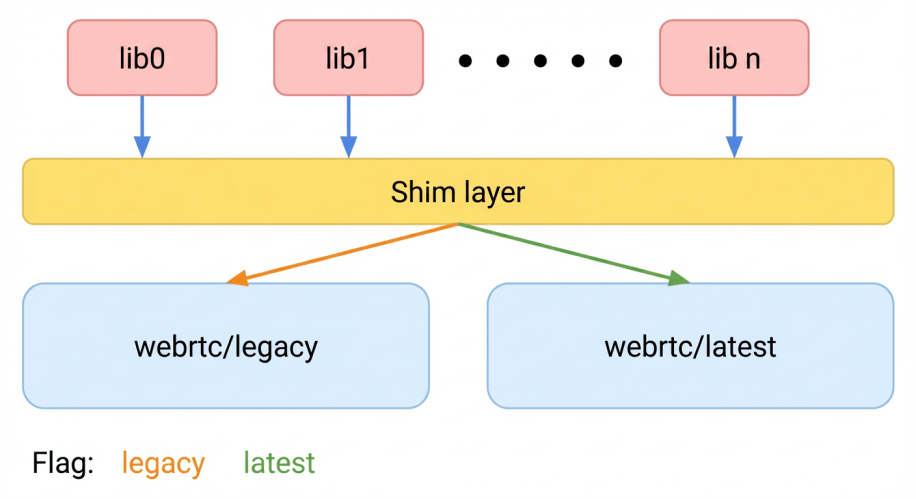
Meta’s solution was a dual-stack architecture that allowed building two versions of WebRTC simultaneously within a single library. This approach enabled safe A/B testing by dynamically switching users between the legacy and new implementations. Key components included:
- Symbol hiding and namespace isolation to prevent ODR violations when statically linking both versions.
- Modular design where upstream WebRTC served as a skeleton, and Meta’s proprietary components were injected as replacements.
- Feature flags to route traffic to either version in real time, measuring performance, binary size, and security improvements without deploying separate app builds.
How Symbol Conflicts Were Resolved
The team used compiler and linker techniques to mangle symbols of one version, effectively creating two distinct namespaces within the same binary. This allowed both WebRTC forks to exist side by side. Additionally, they wrapped upstream APIs with internal abstractions, so Meta’s custom code could call either version transparently.
Continuous Upgrade Workflow
With the dual-stack architecture in place, Meta established a pipeline to continuously integrate the latest upstream WebRTC releases. Instead of fearing regressions, the team could:
- A/B test each new upstream release against the current fork in production.
- Isolate regressions to specific components using modular design.
- Roll out automatically after validation, ensuring all 50+ use cases benefited from community bug fixes and performance improvements.
Results: Performance, Size, and Security Gains
This migration delivered measurable benefits. Binary size decreased due to the removal of duplicative forked code, and performance improved because the upstream WebRTC regularly optimizes codecs and network handling. Security also saw gains, as Meta now receives upstream patches without delay. The company continues to use this methodology today for every new release, effectively breaking the forking trap for good.
Lessons for Other Organizations
Meta’s experience offers valuable lessons for any company maintaining a significant open-source fork:
- Invest in modular architecture early to isolate custom logic from upstream base.
- Prioritize A/B testing infrastructure to de-risk upgrades at scale.
- Embrace the monorepo by using advanced build and linker techniques to handle symbol collisions.
As discussed in The Challenge section, the static linking issue was the hardest to overcome, but it was solvable with the right engineering focus.
Conclusion
By escaping the forking trap, Meta transformed WebRTC maintenance from a liability into a strategic advantage. The dual-stack architecture and continuous upgrade workflow now serve as a blueprint for managing large-scale open-source dependencies in a monorepo environment. For companies facing similar challenges, the lesson is clear: with careful design, it’s possible to keep the benefits of an open-source project while also tailoring it to unique requirements.
Related Discussions